

Latest
Samoa Observer engaged in the active spread of ‘fake news’ – BBC Study finds

Staff Reporters/
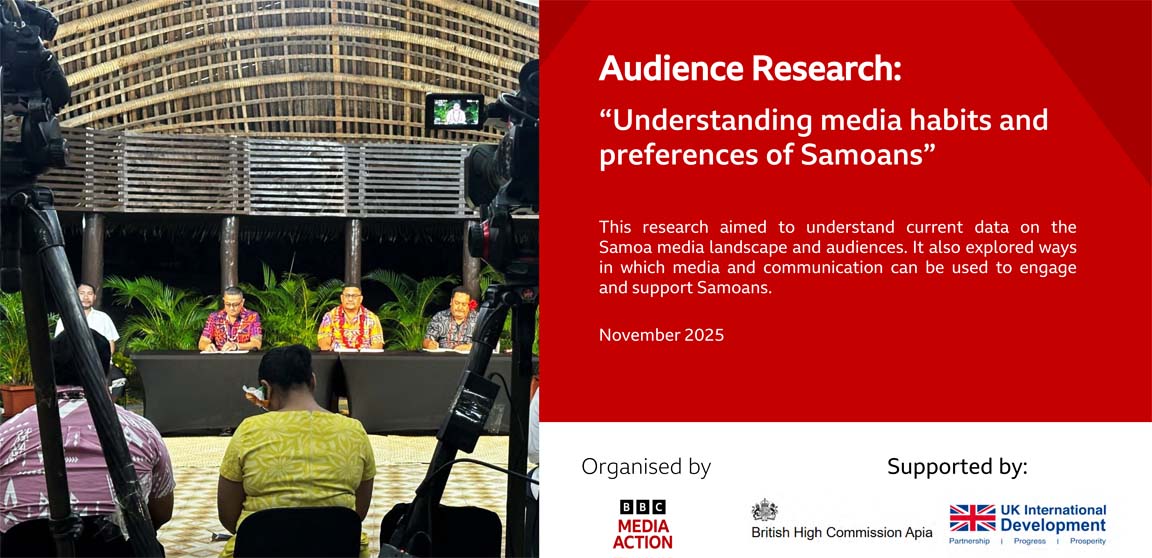
Apia, SAMOA – 27 January 2026 – The BBC Samoa Audience Survey 2025 findings released in Apia last November said of the Samoa Observer newspaper that “some audiences believe it to be a source of false information.”
Under the section on Newspapers, the BBC Research on Audience habits in Samoa and media use, said the Samoa Observer is one of the more widely read news providers, both in print format and via its Facebook page.
“However, some audiences believe it to be a source of false information, with some accusing the outlet of wrongdoing, such as engaging in the active spread of ‘fake news’ and misrepresentation of some of its sources,” a female source in rural Savaii is highlighted in the study.
The research report said that the “overall access to print newspapers is low, with fewer than a quarter (23%) of Samoan mobile users reporting access. Notably, just 15% have newspapers available at home, suggesting that contact with print newspapers is often via public or shared spaces such as workplaces, shops, and cafés.”
According to the research “Media access is dominated by internet, particularly via smartphones, although connectivity is not consistently available.”
Overall Media access through the internet is recorded at 99%. TV 67%, Radio sets 54% and Newspapers 23% mainly in the urban area.

The research results presented is part of a broader three-year initiative by BBC Media Action to strengthen the capacity of media and communication practitioners in Samoa.
The project aims to support the development of high-quality, accurate, and inclusive public interest media that serves all communities, especially those currently underserved.
This report outlines the findings of a programme of research conducted to inform the project and its stakeholders about the media landscape in Samoa, and to set a baseline for the media strengthening activities being carried out as part of this project.
The BBC Media Action partnered with Tebbutt and Tautua Arts Limited to conduct the data collection across Samoa.

Samoa Observer Newspaper continues to be banned
Away from the BBC study, the newspaper is currently banned by the Prime Minister from Ministerial press conferences after several incidents that include breach of privacy, lack of respect, failure to uphold the media ethics when the paper refused to retract or correct a story of a purported meeting between two senior Chief Executive Officers that was to upstage the Prime Minister’s position while on medical leave in New Zealand.
A number of senior public officials have also complained about being quoted in stories published in the paper without being contacted or having spoken to anyone from the newspaper at all.
The BBC Audience Research included online news and social media, and traditional media including Radio, TV and Newspapers.
The Research report also includes an update on digital and cellular mobile connections.
As of early 2025, Samoa had around 185,000 active cellular mobile connections, representing 84.6% of the country’s population.
But the report said “it’s important to note, however, that many of these connections may be limited to voice and SMS services, without necessarily providing internet access.”
Click the link below to go to the BBC Samoa Audience Research Report- 2025.
BBC Samoa Audience Survey 2025 Launch Event Presentation










Feiloaiga a le Afioga ile Palemia ma le Vasega o Tusitala & Au Faasalalau – 2 Aperila

Lavasiga o le Aso: 06 Faamasinoga, HRPP SUPA, Vaalele Fou, Ola Faalagolago – 22 Iuni 2025


