

Court
Judges warn counsel who questioned Court’s integrity in handling Falealili 1 petition

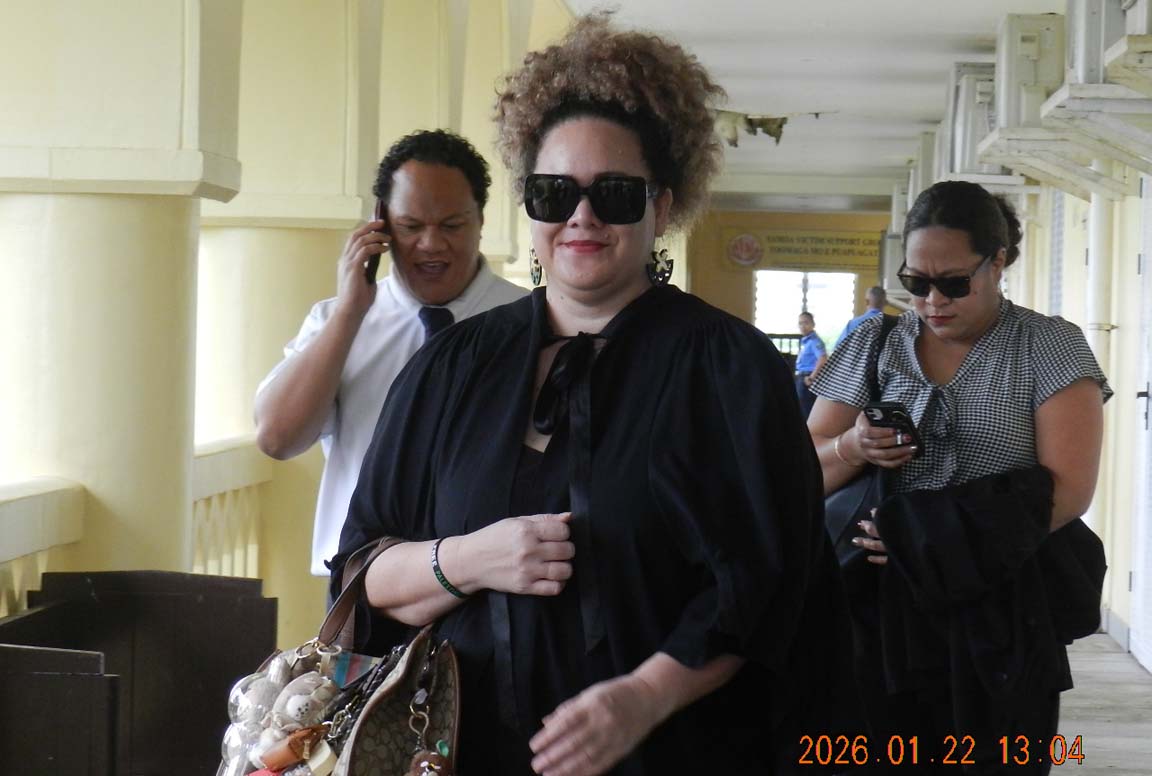
By Lagi Keresoma/
Apia, SAMOA – 23 January 2021 – The integrity of the Election Court in handling the Falealili 1 petition was questioned by counsel Muriel Lui at yesterday’s hearing on the admissibility of evidence of missing witnesses.
Presiding over the case were Chief Justice Satiu Simativa Perese and Justice Leiataualesa Daryl Clarke.
Lui who represented the Falealili 1 Member of Parliament who is the Deputy Prime Minister, Toelupe Poumulinuku Onesemo (Respondent) was direct when she challenged the process of the court.
Central to her argument is the evidence of Lepagatele Alema for Tuiloma Laniselota Lameko (Petitioner) who claimed that the two missing witnesses, Malili and Faagoto told him that Toelupe’s agent allegedly gave them $150.
Lui argued that Alema’s affidavit is hearsay and should not be admissible.
But Chief Justice Perese pointed out, “This is a law-abiding standard and the court can take into account hearsay evidence.”
Justice Clarke referred counsel to Section 126 (3) of the Electoral Act 2019. “The Court may examine a person required to attend or a person in Court, although the person is not called or examined by a Party to the petition.”
According to Justice Clarke, the court does have the power to then ask Muriel if she had an issue with that.
The Court reminded Lui that her client did not rebut Alema’s affidavit and that she was given a chance to address and respond to the claim which her client did not do. “So do not come crying now for a chance.”
Judges warn Counsel several times
Lui also put to the court that the handling of the case is one-sided, and it seems that the court has gone out of its way to prove her client is guilty.
Justice Clarke warned Muriel several times to be very careful of what she was alluding to.
Muriel argued that the court is concentrating on one side of the allegations regardless of the fact ……
However, Chief Justice Perese cut in and reminded Muriel that there is an allegation of unlawful election involving corruption practice.
“And you are saying that’s something simple?” asked CJ Perese.
“I’m not saying it’s simple, I’m saying it’s one sided,” said Lui.
Muriel further said that her perspective is based on how the court is concentrating in supporting this witness.
Justice Clarke reminded Muriel that there is one witness that already says that Malili and Faagoto were allegedly given money by the Respondents agent.
“Are you suggesting that there is bias or prejudice in terms of, is there any other evidence by the Respondent that was pursued?” asked Justice Clarke.
“Yes, Your Honour, I’m saying it’s prejudicial to the Respondent,” Lui responded.
CJ Perese pointed out that what counsel said was one sided but there are two other witnesses who failed to appear on summons of the court and they are not supported by 60 other people who disobeyed the order of the court.
“Should we turn a blind eye?” he asked.
Justice Clarke pointed out that the court is asking these questions because counsel had raised something of a concern.
“Yes, Your Honour, I do acknowledge that and you said the two witnesses are part of 60 other witnesses,” she said.
“Your client elected not to respond, and you closed your case because he thought that we would not accept hearsay evidence,” said CJ Perese.
Lalau David Fong who represented the Attorney General’s Office said accepting hearsay evidence is not new and it was their office who suggested this to the court.
He cited some cases from Russia, Germany and the United Kingdom that had similar bearing to the current case of witnesses not turning up to give evidence but already provided affidavits.
He also reminded the court of the timeline that such electoral matters should be closed and noted that it is now 5 months since the general election.
Justice Clarke reminded Lalau that after the 2016 general election, some of the electoral petition decisions were only delivered after one year, so it is not new.
He did however note that this case is very unusual.
The court has reserved its decision.












Feiloaiga a le Afioga ile Palemia ma le Vasega o Tusitala & Au Faasalalau – 2 Aperila

Lavasiga o le Aso: 06 Faamasinoga, HRPP SUPA, Vaalele Fou, Ola Faalagolago – 22 Iuni 2025


